
What’s in this mess:
I died a hundred times so you don’t have to
Let me tell you about my first proper Frostpunk 2 run. I was smug. I had played the original until my mouse hand cramped. I knew cold. I knew discontent. I knew Londoners were whiny little shits. Then I dove into Act 1, built a cozy little district layout, patted myself on the back, and I got absolutely flattened by Week 40. Not by the frost. Not by the Londoners. By the fact that I ran out of coal in the middle of a whiteout and had to watch my generator stutter and die like a flu patient in a blizzard.
This game is not polite. It is not friendly. It will let you build a gorgeous city and then quietly remind you that you forgot to expand your food districts three weeks ago, and now everyone is eating sawdust and hating you for it. I love it. I also hate it. And I’m writing this guide because the tutorial is a liar and the game’s difficulty curve is a brick wall painted to look like a gentle slope.
If you’re reading this after rage-quitting, I get it. This guide is for you. I’ll walk you through the real pain points — the stuff that makes you reload saves at 2 AM — and give you the exact fixes I had to learn through four dead cities and a lot of coffee.
The stuff that makes you alt-F4
The biggest trap in Frostpunk 2 is that it looks like a city builder but behaves like a survival horror. You think you’re laying down roads and planning nice housing blocks. The game thinks you’re managing a starving colony on a frozen rock that is actively trying to kill everyone. These are the three things that crushed me first:
- Heat management is the only real currency. Coal, oil, steam — you think these are resources. They’re not. They are life support. If your generator goes down, your entire city dies in about 15 in-game days. I lost my first run because I overbuilt housing districts without upgrading my generator’s heat output. The houses were beautiful. Everyone froze to death in them. Monument to my own stupidity.
- Discontent isn’t bad — it’s a resource. This is the single hardest mental shift. In the first game, discontent was a death sentence. In Frostpunk 2, you can (and should) let it ride around 60-70% if it means you get critical laws passed. I spent my second run terrified of making people mad. I passed only “nice” laws. My city collapsed because I didn’t have child labor and sawdust meals to keep production up during a whiteout. The game wants you to make hard choices. Let them be mad. They’ll get over it once the food arrives.
- Research pacing will kill you. The tech tree is a maze of bad options. I spent my third run rushing steam heaters because they sounded great. They are. But I ignored coal thumpers and hothouses for too long. By the time I had fancy heating, I had no fuel to run it. The game punishes “one-track” research. You need to balance heat, food, and industry roughly evenly. If you go three research cycles without touching food, you will see starvation warnings before you can finish the next tech.
The rage-quit moment for most players is the first whiteout. You think you’re ready. You have 2,000 coal in storage. Nice try. A whiteout in Act 1 can consume 300 coal per day on a basic generator setup. That 2,000 coal lasts a week. The whiteout lasts three. The game does not tell you this. It just watches you burn.
Hard-earned tip from a frozen veteran:
Before your first whiteout, overproduce coal by exactly 40% of what you think you need. Not 20%, not 30%. 40%. The reason is that the generator’s fuel consumption doubles during emergency shifts and triples during full whiteouts. If your coal income is 100/day, you need 140/day minimum to survive. I checked my logs. Every death I had was because I was 10-15 coal short per day. Ten coal. That’s the difference between life and a frozen mass grave.
Your first 30 weeks without crying
Here’s what you need to do from day one. Not the tutorial’s version. The real version.
Week 1–10: Build for heat, not for looks. Place your first housing district directly adjacent to the generator. The range bonus is massive early on. A district one tile away from the generator costs like 40 heat per day. A district three tiles away costs 100+. That difference is a whole extra coal mine you didn’t build. I put my housing as close as physically possible, then radiate industry outward. It looks ugly. It works.
Week 10–20: Rush the coal economy. Your first research should be Coal Thumpers. They are cheaper than advanced mines, require less workforce, and produce consistently. Pair them with a gathering post for extra efficiency. Once you have thumpers, stack two coal storage depots near the generator. You think 1,000 coal is enough. It’s not. 2,000 is the minimum to feel safe. 3,000 is where you stop panicking.
Week 20–30: Food is your next crisis. By week 20, your starting food stockpiles are gone. You should have at least two hothouses (or equivalent) running by then. Not one. Two. Because the first whiteout will cut your food production by 50%. If you have one hothouse, you starve. If you have two, you scrape by. I lost a run because I had a single hothouse and the whiteout hit. I watched the food counter tick down like a slow timer on a bomb.
Also: build a second gathering post immediately. The first one fills up fast. The second one lets you double-dip on the same resource pile. This is a weird quirk of the game that you can exploit — two gathering posts on one infinite deposit? Yes. Do it. I don’t know if it’s a bug or a feature, but it’s the difference between having steel and not having steel.
The stuff the tutorial doesn’t tell you
These are the tricks I learned the hard way, usually after a reload. Some of them feel like cheating. They’re not. They’re just how the game works if you pay attention.
- Emergency shifts are not a panic button — they are a plan. A lot of new players save emergency shifts for when things go wrong. Wrong move. Use emergency shifts proactively. When you have a stockpile of food and coal, run an emergency shift on your research lab for one day. That’s 12 hours of free research. Do it twice a week. You’ll finish tech trees two weeks faster. The discontent is worth it. Just make sure you pass the Emergency Shift Safety Law early to reduce the chance of accidents. Yes, that law is in the game. Yes, you need it.
- Roads are not free — stop building them everywhere. Roads cost time and labor to maintain. Every road segment adds to your city’s maintenance burden. I built a sprawling road network in my second run to connect every district. It looked great. My maintenance costs skyrocketed, and I had no idea why. Roads are useful, but you don’t need a connection between every single district. Build only the roads you need for logistics. A straight line from the generator to your exterior industrial district is fine. Don’t pave the whole map.
- The “Automaton” skill tree is a noob trap on hard difficulty. Automatons seem amazing — free labor, no discontent, no food needs. The catch is they consume huge amounts of coal and require high-tier research to be effective. If you rush automatons on a hard run, you’ll drain your coal reserves and have a bunch of useless robots standing around during a whiteout. I recommend skipping them entirely on your first few runs. Human labor is cheaper, more flexible, and you can feed them sawdust. Robots can’t eat sawdust. That’s a win for the humans.
- Laws are not permanent — you can repeal and amend. I think a lot of people forget this. If you pass a law that turns out to be terrible (looking at you, Faith Keepers), you can repeal it later. It costs some influence and a bit of time, but it’s not a permanent mark on your soul. I passed Child Labor early, used it to get through the first whiteout, then repealed it at Week 60 when I had a stable workforce. The game lets you be pragmatic. Be pragmatic.
One more thing about laws: the Order tree is generally stronger than Faith for early game. Order gives you flat production bonuses and reduced discontent effects. Faith gives you hope and fervor, which are nice, but they don’t stop your generator from running out of gas. Go Order first. Faith later when you have resources to spare.
The mistakes that ended my first three cities
I’ve already mentioned a few, but let me list the big ones in one place so you can avoid them:
- Overbuilding districts too fast. Every district costs heat and workforce to maintain. I built five housing districts in my first run because I thought “more housing = more people = more workers.” Wrong. Each empty district still costs heat. I had three housing districts with 0 residents because I hadn’t researched population growth yet. They were just sucking my coal and giving me nothing. Build districts only when you have the population to fill them. Empty districts are dead weight.
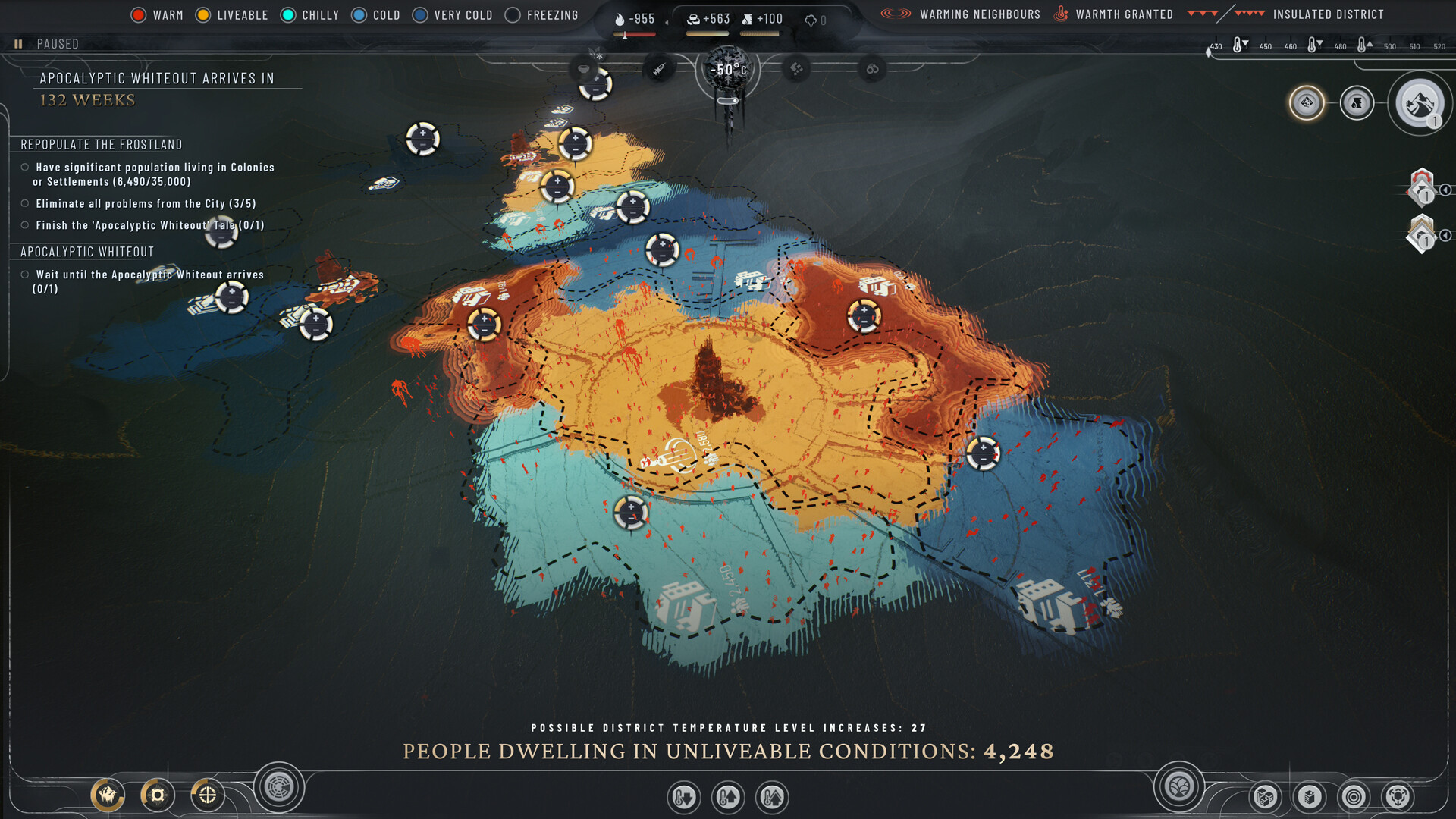
- Ignoring the “Cold” hazard mechanic. This is subtle. When a district gets too cold, it can spawn cold hazards — random events that hurt your city. I had a housing district get a cold hazard event that killed 20 people instantly because I didn’t have enough heaters. The game doesn’t scream at you about this. It just shows a little icon. Watch the icons. If a district is “Cold” or “Very Cold,” you need to either upgrade its heating or move it closer to the generator. Dead people are bad.
- Not stockpiling before the first storm. I touched on this earlier, but it’s worth repeating: stockpile everything starting at week 25. Coal, food, wood, steel. The first storm hits around week 40–45 depending on difficulty. If you have less than 5,000 coal at week 40, you are in danger. I had 2,000. I died. The storm is not the time to build new mines. It’s the time to sit on your stockpiles and pray they last.
- Saving the game too rarely. This game has autosave, but it’s not frequent enough. I lost four hours of progress because I didn’t manual save before a whiteout. The whiteout killed my city. My last autosave was from before I built my food districts. I had to rebuild everything from scratch. Save every 10 weeks manually. It’s boring. It’s worth it.
Questions I get asked by friends who also hate winter
Q: What’s the best starting law?
A: Child Labor (Safe Jobs). It gives you a workforce boost early when you need it most. If you’re morally uncomfortable, repeal it later. The game doesn’t judge you. I judge you only if you starve because you refused to put kids to work. Priorities.
Q: How do I deal with Londoners?
A: Londoners are a side effect of high discontent and low hope. To reduce them, you need to either raise hope (build public houses, pass hopeful laws) or lower discontent (pass order laws, keep people fed). The Patrol law in the Order tree is the fastest fix. It cuts Londoner growth by a lot. Combined with Propaganda Center, you can shut them down entirely. Yes, it feels dystopian. The city is frozen. Be pragmatic.
Q: Is the “Generator Upgrade” worth it early?
A: Only the first two levels. The Generator Range Upgrade and Generator Power Upgrade are critical. Anything beyond that is a late-game luxury. The third level of power upgrade costs a ton of resources and gives a small boost. Spend those resources on coal thumpers or hothouses instead. You’ll get more survival value per resource point.
Q: What about the lore — should I read the story?
A: Yes, but don’t let it distract you. The lore is good, but the game doesn’t pause while you read it. I lost a run because I was reading a lore popup and didn’t notice my coal had dropped to zero. Read during safe moments, like when you’re waiting for research to finish.
Q: Is this game harder than the first one?
A: In some ways, yes. The scale is bigger, the threats are more complex, and the resource chain is longer. The original game was about surviving a day at a time. This one is about surviving a year at a time. It’s a different kind of pressure. If you liked the original, you’ll like this, but expect to fail a few times. For a similar “tough but fair” survival experience, you might also enjoy our Banished guide. That game also punishes overconfidence with starvation.
Q: Can I play this like a chill city builder?
A: On the easiest difficulty, yes, barely. On normal, no. This game is designed to stress you out. Embrace the stress. It’s the point.
Disclosure: This guide may contain affiliate links. If you purchase games or products through these links, we may earn a small commission at no extra cost to you. This helps support our work in creating free, high-quality guides. All opinions and recommendations are our own.
Sign in to post a comment.
Sign in with GitHub to join the discussion.
💬 Comments
What players are saying:
Wish I’d read this before my third run. The tip about empty districts wasting heat — that was exactly what killed me. I had four empty housing districts just sucking coal. Also, the 40% extra coal rule saved my current run. Whiteout hit at week 42, I survived with 200 coal left. Closest call I’ve had. Thanks.
Disagree on the Automaton take. I used them on my first hard run and they carried my lategame when I had coal surplus but no workers. But yeah, they suck if you rush them. I made that mistake. The guide is right that you need a solid coal base first. Good call on the Order tree too — Faith is for roleplay runs only.
The gathering post double-dip trick is insane. I didn’t know you could stack two on the same infinite deposit. That alone doubled my steel production. Also, the part about roads costing maintenance — I never noticed that. No wonder my economy was tanking. Removed half my roads and suddenly I had surplus. This guide is full of stuff the game hides. Good write-up.