

Skip to a Section
So You Bought Stellaris. Now What?
Yeah, this game is a lot. I remember my first run — I picked the United Nations of Earth because I wanted to feel like the good guys, spread democracy, make first contact with friendly aliens. Four hours later, a fanatical purifier empire called the "Zerg But Worse" had eaten my entire eastern flank, my economy was in the toilet because I built three starbases I couldn't afford, and my only ally was a hive mind that kept asking for my homeworld's population as a "gift." I rage-quit and didn't touch it for three months.
But then I came back. And I figured it out. And now I've got 1,200 hours in this bastard of a game. Stellaris is brutal at first because it doesn't tell you how anything actually works. The tutorial shows you how to click buttons, not how to win. It gives you a science ship and a construction ship and says "go have fun" while the galaxy is actively trying to murder you.
What makes it special is the stories it generates. I've had a run where my spiritualist empire accidentally created the Chosen One through a shroud event and he became a god-emperor who ruled for 200 years. I've had a run where a peaceful federation of trader species got wiped out by a crisis because I forgot to build a gate network. The game is a storytelling engine wrapped in spreadsheets, and once you get past the wall of confusion, it's one of the most rewarding strategy games ever made.
But let's be real — the early game is punishing. The midgame is confusing. And the endgame is either a boring stomp or a sudden wipeout. I'm going to tell you exactly how to handle all three phases without spoiling the discovery for you.
Why This Game Makes You Want to Throw Your Monitor
You're not bad at the game. The game is bad at explaining itself. Here are the specific pain points that made me almost refund it:
- Economy: You think you're doing fine? Check your monthly energy credits. Oh look, they're at -47 and dropping. In 15 minutes you'll be losing ships because you can't pay maintenance. The game doesn't yell at you until it's too late.
- First Contact: That cute alien species that wants to be friends? They're absorbing your ethics. That militarist empire with the skull icon? They're going to declare war the moment you look weak. You have no idea who's a threat and who's not for the first 50 years.
- Tech Rushing: Everyone online says "rush tech." So you max out research labs. Then you realize your alloys production is garbage and you can't build a fleet. Then a neighbor with 20 corvettes shows up while you have 3. Good luck.
- The "First Boss": There's no literal boss, but the first crisis event (usually the Gray Tempest or a Fallen Empire awakening) will absolutely wreck you if you weren't preparing for it. I lost my first three runs to the Gray Tempest because I thought "I'll build ships when I need them." Nope. You need a fleet ready before the bad thing happens.
The core issue is this: Stellaris is a game of snowballing. If you screw up the first 20 years, you'll be behind for the rest of the game. But once you know what to prioritize, it clicks. Let me save you the pain.
First Steps — What I Wish Someone Had Screamed at Me
When you start a new game, here's exactly what should be running through your head for the first 10 years. No fluff, just the stuff that keeps you alive.
- Pick Your Origin Wisely: Don't pick "Prosperous Unification" because it sounds balanced. It's actually one of the strongest starts because it gives you free population and buildings. Avoid "Life-Seeded" unless you want a hard mode where you can only colonize one planet type. If you're new, go with Prosperous Unification or Mechanist (robots are OP for new players because they don't need consumer goods).
- Survey, Survey, Survey: Your first order of business is to queue up survey orders for both your starting science ships. Don't waste time exploring anomalies right away — just find out what systems are around you. You need to know where your neighbors are and what resources are nearby. The first 5 years are about map awareness.
- Build Order: Day one, start building a second science ship. Then build a construction ship. Then queue up a corvette or two. Don't build anything else until you've got those three things working. Your starting starbase should be upgraded to Starbase level 2 within the first 10 years — that gives you more building slots and defense platforms.
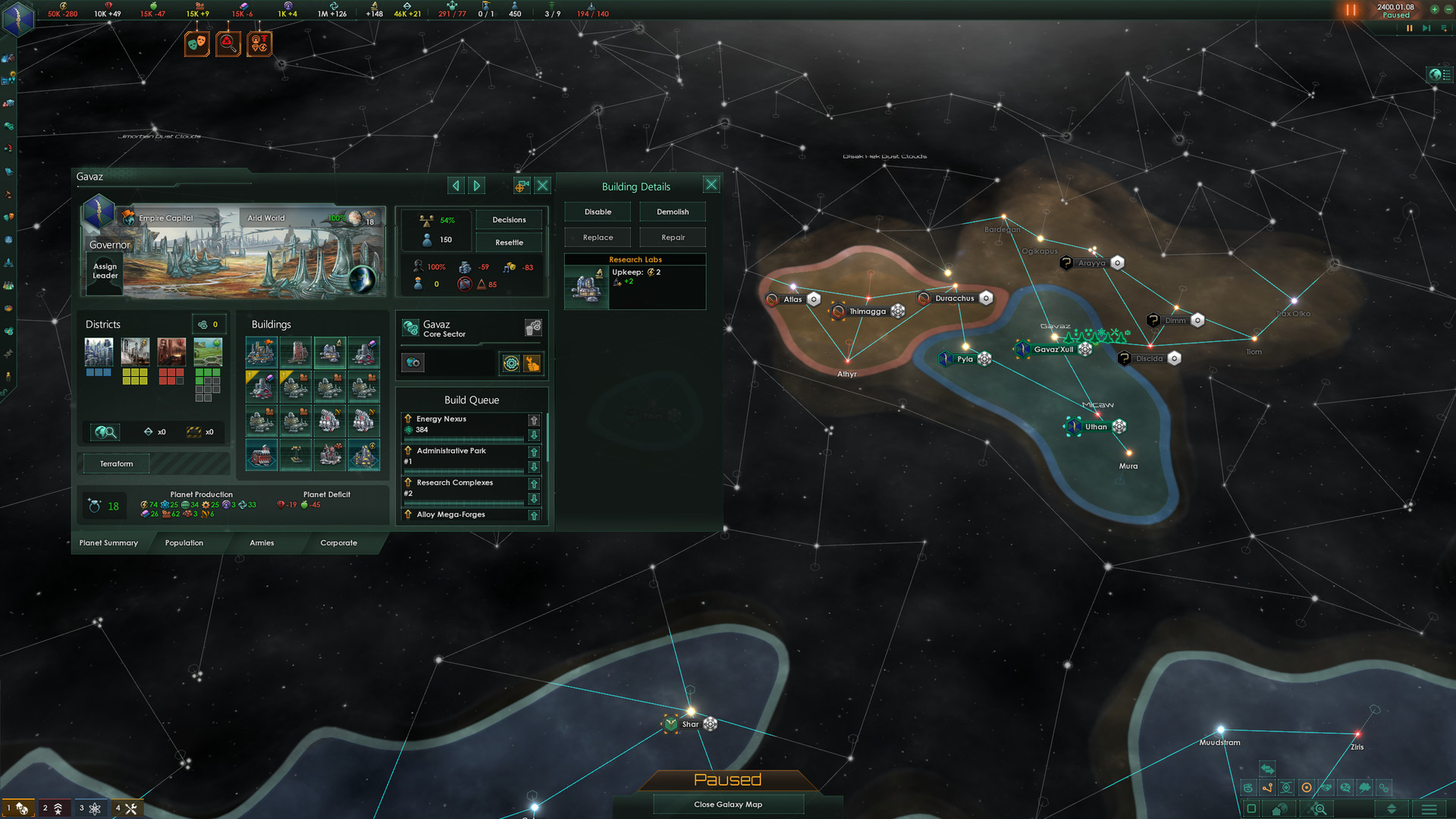
- Homeworld Development: Build a Research Lab first. Then a Mining District or Generator District depending on what you're short on. Don't build civilian industries right away — consumer goods are fine, but you need alloys and research more. I usually go: Research Lab, Alloy Foundry, then a second Research Lab. That gives you a tech edge without bankrupting you.
- First Contact Protocol: When you meet another empire, do not immediately send an envoy to improve relations. Instead, close borders automatically (default setting). Don't sign research agreements until you've got a decent tech lead. And for the love of god, don't agree to a non-aggression pact with someone who has a bigger fleet — they'll break it the moment you're vulnerable.
Your goal for the first 30 years is simple: get your economy positive in all four basic resources (energy, minerals, food, consumer goods), then stack alloys and research. If you're at 30 alloys per month by year 20, you're doing great. If you're at 5, you're going to have a bad time.
Hard-Earned Pro Tip: The Starbase Meta That Nobody Tells You
You know those Defense Platforms everyone says are a waste? They're actually fantastic early game if you build them right. Don't build mixed weapon platforms — build all Kinetic Artillery on one starbase in a chokepoint system. The AI will throw corvettes at it, and Kinetic Artillery shreds corvettes because of the +100% damage to shields. I held off a 6K fleet with a 2K starbase using this trick. But here's the catch: only build defense platforms on your border chokepoints. Everywhere else, save the alloys for ships. I wasted a whole run building defense platforms on every single system and wondered why I couldn't afford a real fleet.
The math: A single Defense Platform with two Kinetic Artillery slots does about 40 DPS against shields. Three platforms = 120 DPS. That's enough to kill a corvette every 3 seconds. Do that in a system with a starbase that has +30% weapon range and you've got a fortress that costs a fraction of a fleet.
Expert Tricks That Aren't in the Tutorial
After 1,200 hours, here's the stuff I figured out that completely changed how I play:
- The Art of the Buffer State: If you have a neighbor you don't want to fight, guarantee their independence. Yes, it costs influence. But it keeps them from getting eaten by a bigger empire, and it gives you a warning if someone attacks them (you get called in with a free casus belli). I've used this to keep a weak empire alive as a shield between me and a Fanatic Purifier. They take the damage, I build up my fleet. When they fall, I swoop in and reclaim their systems.
- Megastructures Are a Trap (Early): I spent my first 500 hours thinking I needed to rush Mega-Engineering. You don't. Megastructures are a mid-to-late game luxury. The resources you spend on the tech and the construction are better spent on fleet power and starbase upgrades. If you get the Horizon Signal event chain, sure, build the Dyson Sphere. Otherwise, focus on Gateways — they're cheaper, faster to build, and let you move your fleet across the galaxy in minutes. A single Gateway network is worth more than any Megastructure until year 2400.
- Pop Growth is King: Every single resource in this game comes from pops. More pops = more research = more alloys = more ships. So the single most important thing you can do is get your pop growth rate as high as possible, as fast as possible. Take the Democratic authority for the +10% growth bonus from the Mandate. Build Robot Assemblies as soon as you can afford them. Colonize every planet within 5 jumps of your homeworld, even if they're 30% habitability. A planet with 30% habitability and robots will still out-produce an empty planet slot.
- War Exhaustion is a Resource, Not a Problem: Most new players try to avoid war exhaustion because it sounds bad. But you can win a war even at 100% exhaustion if you've occupied enough enemy systems. War exhaustion just means your side is tired — it doesn't force surrender. So if you're winning battles but your exhaustion is high, keep pushing. I've won multiple wars where I hit 100% exhaustion and still claimed three enemy systems because my occupation was higher than theirs. The game doesn't punish you for fighting long wars — it punishes you for losing battles.
- The Federation Secret: Federations are powerful, but the default "Galactic Union" type is slow. Instead, create a Trade League if you can. Trade Leagues give +10% trade value to every member, and trade value translates into energy credits and consumer goods. If you're a megacorp, this is insane — I had a game where my trade value was +200 per month just from the federation bonus. Also, never vote on federation laws until you have the most diplomatic weight. The AI will screw you over with laws that benefit them. Always become the federation president first, then push your agenda.
One more thing that took me way too long to figure out: you can re-order your fleet's combat computers. Click the fleet, look at the ship design tab, and set your corvettes to Swarm Computer and your destroyers to Picket Computer. The AI puts everything on "Aggressive" which makes them dive into the enemy and die. Swarm computers keep your corvettes at range and maneuvering. It's a huge difference in survivability.
Common Mistakes That Got My Ass Killed
I've made every mistake in this book. Here's what cost me runs and how to avoid it:
- Mistake #1: Building Every Building on Every Planet: Your homeworld should be a research and alloys hub. Your second planet should be mining and energy. Your third planet should be consumer goods and food. Don't mix. I built a commercial zone and a research lab on the same planet for 200 hours before I realized I was halving both outputs. Specialization bonuses from planetary designations are huge — a Forge World gives +20% alloys for half the upkeep. That's massive. Build dedicated planets.
- Mistake #2: Ignoring Crime and Stability: You think crime is just a number? It's not. High crime means reduced stability. Low stability means reduced resource output. I had a run where my capital went to 30% stability and my research dropped by 40% — took me 50 years to recover. Build a Holo-Theatre on every planet with more than 20 pops. It's two building slots, but it gives +10 stability and entertains your pops. The production boost pays for itself in 10 years.
- Mistake #3: Not Using Ambassadors Correctly: Your envoys (early game) should be on first contact or spying, not improving relations. Why? Because you don't know who your enemies are yet. Spying gives you intel on their fleet power, economy, and ethics. If you see an empire is "Overwhelming" in fleet power, you know to be nice to them. If they're "Pathetic," you can eat them. I spent my first 200 hours improving relations with everyone and ended up with no intel, then got surprised by a war. Envoys on espionage give you hard data, not vague feelings.
- Mistake #4: Over-Expanding: It's tempting to colonize every planet you see. But every colony costs influence per month (base -1 for each colony). If you have 5 colonies, you're losing 5 influence per month. Influence is used for edicts, claims, and diplomatic actions. You need those. Cap your colonies at 3-4 planets until you have a positive influence income of at least +3 per month. I lost a war because I had 8 colonies, was at -3 influence, and couldn't afford to claim any enemy systems. Expand slow, consolidate fast.
- Mistake #5: Forgetting Traditions: You know Unity exists, right? A lot of new players ignore Unity because it seems abstract. Unity unlocks Traditions which give huge passive bonuses. The Discovery Tradition tree gives +20% research speed. The Supremacy Tradition gives +15% fleet damage. Always pick Discovery as your first tradition tree if you're tech-focused, or Supremacy if you're going militarist. I did an entire run without finishing a single tradition tree and wondered why my empire felt weak. Traditions are free stats. Use them.
Frequently Asked Questions (No, You're Not Stupid)
Q: How do I know which empire to attack first?
A: Look at the Fleet Power tab in the contacts screen. If an empire is "Equivalent" or "Inferior" to you, and they have no defensive pacts, you can probably take them. But check their ethics — if they're Pacifist, they won't attack you, so you have time. If they're Militarist, they will attack you the moment you look weak. I usually attack the nearest "Pathetic" fleet power empire that isn't a federation member. Clean them out, take their systems, use their pops.
Q: What's the best ship design early game?
A: For the first 50 years, build Corvettes with 2x Red Laser and 1x Armor. Lasers have high accuracy and good damage against armor (which most early enemies have). Don't waste alloys on destroyers until you're in year 50+ and facing bigger ships. Also, never build a mixed fleet of corvettes and destroyers early — the destroyers will die to corvettes because they're slow and inaccurate at close range. Pure corvette fleets are the meta until you unlock cruisers.
Q: How do I deal with the end-game crisis?
A: Prepare before the crisis spawns. Build a Gateway network across your empire so you can move your fleet anywhere in 30 days. Stockpile at least 20K alloys. And specialize your fleet against the crisis — for the Unbidden (energy beings), use Shield-Hardening and Missiles. For the Contingency (robots), use Armor and Kinetic Weapons. For the Prethoryn (biological), use Shields and Plasma. If you don't counter-build, you'll lose.
Q: I keep getting attacked by neighbors. How do I stop it?
A: You can't always stop it, but you can make yourself a less appealing target. Keep your fleet power at "Equivalent" or higher to your nearest neighbor. The AI checks your fleet power before declaring war. Also, build a Chokepoint Starbase with 6 Defense Platforms and a Shield Booster Module on the border. A strong starbase makes the AI think twice. If you're desperate, pay tribute — offer them 200 energy credits per month for a 10-year non-aggression pact. It's humiliating, but it buys you time.
Q: What's the deal with the Galactic Community?
A: Join it if you're a Xenophile or Diplomatic empire. Ignore it if you're a Xenophobe or Militarist. The Galactic Community passes laws that affect everyone, but they're mostly useless until the endgame. Don't waste influence voting on small resolutions. Focus on Galactic Council membership if you can get it — that gives you veto power over stupid resolutions. I joined the Community in one run and spent 100 hours just voting on "Galactic Trade Standards" while my empire burned. Not worth it unless you're playing politics.
Q: Why are my leaders dying so fast?
A: Leaders have lifespans. Humans live about 80 years by default. Your starting leader will die around year 50-60. You can extend their lives with Genetic Engineering (give them the "Venerable" trait for +120 years lifespan) or through Psionic Ascension. But honestly, don't worry about it — replace them when they die. The game gives you new leaders automatically. The only time this is a crisis is if your main admiral dies mid-war. Always have a backup admiral on standby. I lost a war because my lvl 10 admiral died and I had to wait 2 years for a replacement.
Sign in to post a comment.
Sign in with GitHub to join the discussion.
💬 Comments
What players are saying:
Dude, the part about building defense platforms ONLY on chokepoints saved my current run. I was wasting alloys on every border system and wondering why I couldn't afford a fleet. Switched to just two chokepoint starbases with Kinetic Artillery, and now I'm actually holding my ground against a fanatic purifier. That tip alone is worth the read.
I appreciate the honesty about Megastructures being a trap. I've been rushing Mega-Engineering for 400 hours and never understood why I was struggling. Finally tried a run where I just focused on Gateways and pop growth, and suddenly I'm dominating the mid-game. Also, thanks for confirming that Trade Leagues are busted — my megacorp run went from 50 energy to 500 per month after I formed one.
Gonna disagree on the corvette-only meta. I've had way more success mixing 3-4 destroyers with kinetic artillery into my corvette fleets. They draw fire away from the corvettes and can punch through armor. But I'll admit the chokepoint starbase trick is solid — I held off a 4K fleet with a 1.5K starbase using kinetic platforms. Also, you forgot to mention that you can sell extra food on the market for quick energy in emergencies. Good guide overall if you're a noob.