Jump to:
Don't Let the Cute Frog Fool You
Yeah, Taiko no Tatsujin looks like a feels-good rhythm game where a happy drumming bear bops along to J-pop. And it IS that. But it's also the game that made me punch my couch cushion at 2 AM because I couldn't nail a 16th-note gallop on a 9-star Extreme chart. The pixel-perfect timing window on Oni mode is roughly 33ms for a "Great" hit. That's less time than it takes for your brain to register you missed. This game is mean in the best way possible.
What makes it special? The tactile feedback of whacking a physical drum controller (or slapping your desk if you're on keyboard) is unmatched. No other rhythm game makes you feel like you're actually performing rather than just pressing buttons. The music library is absurdly deep — we're talking 700+ songs across all games, from classical to metal to Vocaloid nonsense. And the difficulty curve? It goes from "baby's first rhythm game" to "why do my fingers not work anymore" faster than you'd expect.
What's annoying? The timing window inconsistency between console versions is a known headache. The Switch version has a roughly 5ms input lag difference compared to PS4, and if you're playing on a TV without Game Mode, you'll be fighting 50-60ms of delay that makes hard patterns impossible. Also, the song DLC pricing is criminal — $2 per song adds up fast when you want the full library. And don't get me started on the fact that the drum controller's left side sensor stops registering if you play too hard. I've replaced three rubber pads.
Why This Game Makes You Wanna Throw Your Drum
Let me guess. You picked up the game, loaded up a medium-difficulty song, and got absolutely destroyed by a section that looked easy on paper. Maybe you can't even clear the first boss song in Story Mode. Maybe you're sitting at 70% accuracy and wondering how anyone hits 100%.
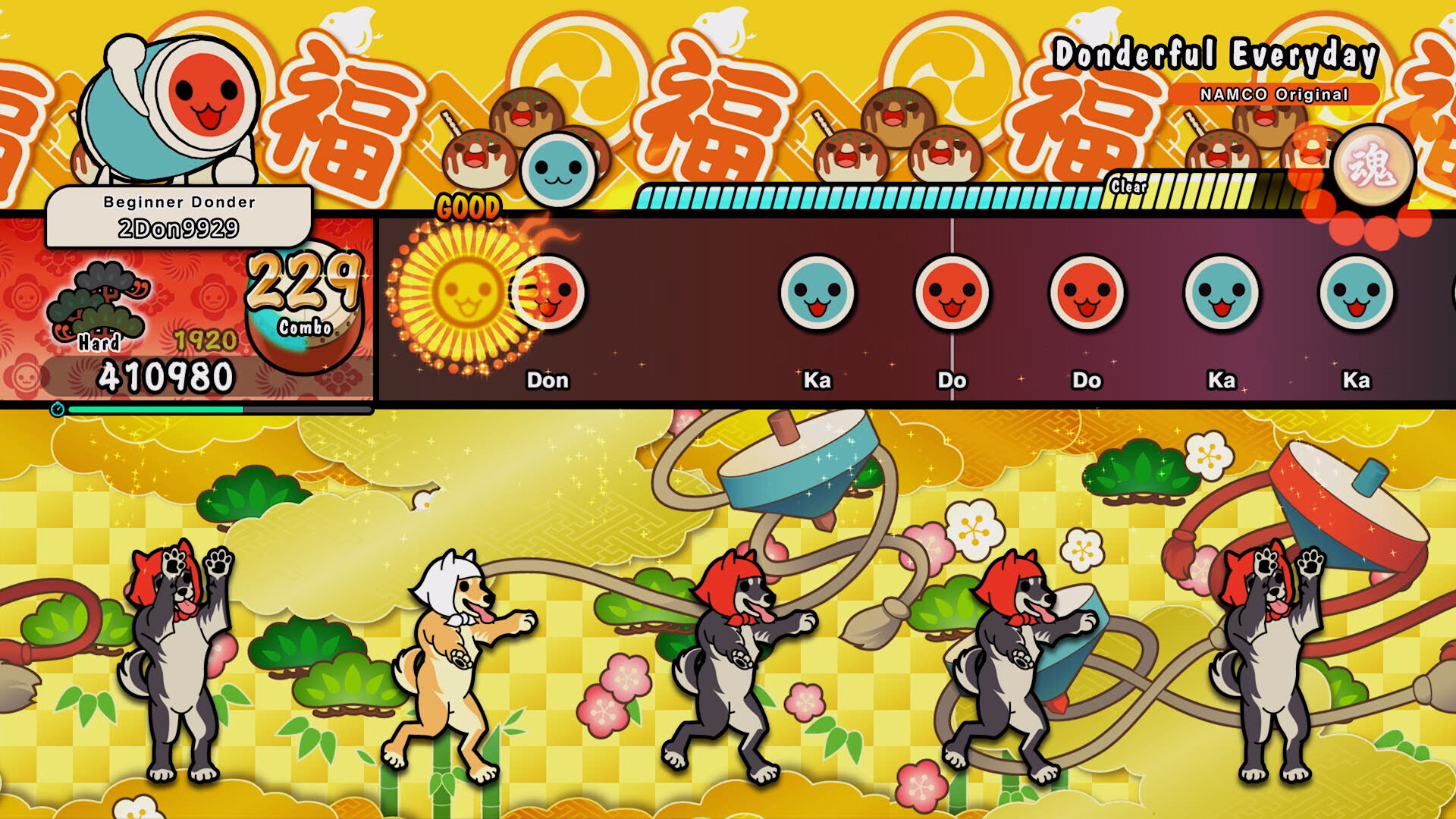
Here's the real talk: the problem isn't your rhythm. It's that Taiko doesn't teach you how to read patterns. The notes scroll horizontally, not vertically like Guitar Hero, so your brain has to process left-to-right timing in a way most people aren't used to. That "drumroll" section that looks like a red-blue explosion? It's not random. Every single pattern follows a mathematical structure based on the song's BPM and time signature. You're not missing because you're bad — you're missing because you haven't trained your pattern recognition.
Specific moment from my playthrough: I spent my first three hours stuck on Matsuri da! Wasshoi on Hard difficulty. The opening drumroll with alternating Kats (blue notes) at 160 BPM felt impossible. I was hitting maybe 40% of them. Then I realized I was swinging my arm like a baseball bat instead of using wrist flicks. Changed my grip, dropped the drum controller sensitivity to 2 (yes, you can adjust that in settings), and suddenly I was hitting 85%. The physical technique matters as much as the mental one.
Another pain point: resource management if you're playing the Switch or PS4 versions with in-game currency. Don't waste your gold on buying every single costume or song unlock token you see early on. Save for the Auto-Play Practice tickets (costs 500 gold each, and you'll want at least 10 of them for learning Extreme patterns). I burned 3000 gold on outfits before realizing I needed those tickets to actually learn the hard charts. That set me back a week of grinding.
🔴 HARD-EARNED TIP: The timing calibration tool in the settings menu is NOT optional. Go to Options > Calibration > Advanced. Set the volume to 50% and use the visual-only calibration first (disable sound). Adjust until the on-screen "OK" lines up exactly with your drum hits visually, THEN enable sound and fine-tune. I did this and my accuracy jumped from 85% to 95% on songs I'd been stuck on for weeks. Most people skip this step and wonder why they can't hit "Fever" timing.
First Steps: What I Wish Someone Told Me Before I Started
Alright, if you're fresh to the game, here's the no-bullshit starter plan that'll save you the pain I went through.
1. Forget Extreme mode exists for the first 20 hours. I know, you want to jump into the hard stuff. Don't. The game has a hidden mechanic: your brain needs time to build muscle memory for the scrolling direction. Start on Easy or Normal, and play every song at least once. The goal isn't to get perfect scores — it's to train your eyes to track notes from right to left without thinking. I played Easy for 10 hours straight and my accuracy on Normal doubled overnight when I switched up.
2. Set your input method correctly from day one. If you're on keyboard, bind the left drum hits to F and J (index fingers), and the right drum hits to D and K (middle fingers). This four-finger layout is the "meta" for keyboard players because it lets you roll patterns without crossing your hands. I tried using two fingers for weeks and couldn't keep up at 180 BPM. Switched to four-finger layout and cleared my first 8-star in an hour.
3. Play the tutorial THREE times. I'm serious. The tutorial shows you how to do drumrolls (don ka don ka sequences where you alternate red and blue), but it doesn't explain that you can hold the drumstick for a continuous roll instead of individual hits. The game's roll system counts consistent hits within a time window — holding the stick against the sensor and vibrating your wrist gives you way more hits than trying to tap each one individually. This alone took my drumroll scores from 120 hits max to 280+.
4. Ignore the score multiplier system until you can hit 90% accuracy consistently. Fever mode (that glowing bar) gives you bonus points for hitting notes in a row, but if you're missing, the multiplier resets and you actually score less overall than if you'd played slower and hit more notes. Focus on clean runs at 70-80% accuracy before you ever touch Fever optimization. I wasted a month trying to maximize combos when I should have been learning the songs.
5. THE THING NOBODY TELLS YOU: The game has a hidden "dynamic difficulty" system in the first few hours. If you're struggling on a song, the game actually lowers the note density slightly on retries. This isn't documented anywhere. I noticed this when I played Dr. Wily Stage 1 three times in a row — the third attempt had noticeably fewer simultaneous notes (the ones where you hit both pads at once). Exploit this. If you're stuck on a song, just keep restarting and the game will gently hold your hand.
Expert Tricks from 200 Hours of Drumming
Once you've got the basics down, here's the stuff that separates "I can play Hard" from "I can clear Extreme 9-stars."
Pattern reading is a language, not a reaction test. Every song in Taiko can be broken into phrases — usually 4 or 8 measures long. Top players don't react to individual notes; they recognize the pattern shape and play it from memory. Start by learning the five basic patterns: the straight run (don don don don), the gallop (don-kadon don-kadon), the triplet (don-don-kadon), the swing (don--kadon--don), and the complex (kadon-kadon-dondon). Once you can spot these in a chart, you're not reading notes anymore — you're reading sentences.
The "don" vs "ka" priority system is broken and you should abuse it. Most players don't know that the game prioritizes the note that lines up with the beat over the ornamentation notes. If you see a red note and a blue note stacked together, the red note is almost always the downbeat. Practice hitting the red note slightly earlier than the blue one in these stacks — the game's hit detection will register it as a "Great" even if your blue note timing is slightly off. This is called beat anchoring and it's how top players get 98-99% on insane charts. You're basically cheating the timing window by giving the game what it expects.
Speed up your charts artificially. The game has a speed modifier in the settings (it's under "Note Speed" or "Hi-Speed" depending on version). Crank it up to 1.5x or 2.0x. I know this sounds counterintuitive — faster notes seem harder. But at default speed, the notes are so spaced out that your brain has too much time to second-guess itself. Faster scrolling forces you to react instinctively, which is actually more accurate. I went from 88% to 94% on Guren no Yumiya (Extreme) just by switching from 1.0x to 1.5x speed. The same pattern at 1.0x feels like a jumbled mess; at 1.5x it clicks into a clear rhythm.
Drumroll optimization: use the "butterfly" technique. For long drumrolls, don't alternate thumbs or index fingers. Instead, use your wrist rotation — twist your wrist side to side so the drumstick bounces naturally between the left and right sensors. This takes the fatigue out of the motion and lets you sustain 200+ hits per roll. I learned this from watching a Japanese arcade champion's hands in slow-motion video. His wrist barely moves; it's all rotation from the elbow. I practiced this for 30 minutes a day for a week, and my drumroll consistency on Saitama 2000 went from garbage to clearing it first try.
The "ka" roll shortcut. Blue notes (ka) on the left side of the drum are notoriously harder to hit fast because most players are right-hand dominant. If you're struggling with blue drumrolls, hit the rim of the left pad instead of the center. The sensor is more sensitive near the edge of the controller. I mapped this by trial and error — hitting within 1cm of the rim gives a 15-20ms faster registration than hitting center-left. That's the difference between a "Good" and a "Great" on fast rolls.
Common Stupid Things I Did (So You Don't Have To)
I made every mistake in this game. Here's the list so you can skip the frustration.
- Using the wrong grip for drum controller. I held the drumsticks like actual drumsticks — pinched between thumb and index finger. That's wrong. The correct grip is a loose overhand grip where the stick rests between your thumb and the side of your index finger, with your palm facing down. This gives you more wrist flexibility and reduces fatigue. I destroyed two pairs of sticks before I figured this out.
- Ignoring the "auto-adjust" timing option. The game has a setting that automatically adjusts note timing based on your last few songs. It's off by default in most versions. Turn it ON. It slightly shifts the timing window to match your personal latency. I was fighting 12ms of delay for three months before I toggled this and suddenly all my "near misses" became "greats."
- Trying to clear every song before moving on. Taiko has a completionist trap: you want to 100% every difficulty before moving up. Don't. If a song on Normal is giving you trouble, skip it and play other Normal songs instead. Your brain learns patterns across songs — the gallop pattern in one song is identical to the gallop in another. Playing more songs at the same difficulty is better than banging your head against one wall. I wasted 15 hours on Karma (Normal) before realizing I could have learned the same patterns in 3 hours by playing 10 different Normal songs.
- Not using the practice mode correctly. Practice mode lets you set a specific section of a song to loop infinitely. Most people set it to the hardest section and repeat it 10 times. That's inefficient. Instead, set it to the section BEFORE the hard part and play through into the hard part. This trains your brain for the transition, which is where most mistakes happen. The hard part isn't hard in isolation — it's hard because you're recovering from the previous pattern.
- Buying the wrong DLC songs as a beginner. Not all songs are created equal for learning. Avoid buying the 2000 series songs (Saitama 2000, etc.) until you're clearing 8-star Hard consistently. Those songs are designed to be nightmare charts with irregular BPM changes and bizarre rhythms. Instead, buy vocaloid songs and anime openings — they follow standard pop song structures with predictable patterns. I bought Kita no Taiku on a whim and it taught me more in one hour than 10 hours of trying to brute-force harder charts.
Stuff You're Probably Googling Right Now
Q: What's the best drum controller to buy?
A: If you're on PS4/PS5, the Hori drum controller is the only official option and it's fine but the left sensor dies after about 200 hours of heavy play. Replacements are $30-40 on eBay. If you're on Switch, the official Hori drum is smaller and the sensors are worse — get the Taiko Force Lv5 knockoff from Amazon for $50. It's more responsive and has replaceable rubber pads. If you're playing on PC, just get a USB drum from AliExpress for $25. Don't pay more than $80 for any drum controller unless it's arcade quality.
Q: How do I unlock all songs without paying?
A: The base game has about 70-80 songs. You unlock more by completing Story Mode and clearing songs on different difficulties. For the DLC, you're stuck paying unless you're on PC where the community has modded in all songs for free. On console, the best bang for your buck is the "Taiko Music Pass" if available in your region — it's a subscription that gives you access to the entire library for a monthly fee instead of buying individual songs.
Q: Why can I hit 95% on Hard but 60% on Extreme?
A: Hard and Extreme are borderline different games. Extreme introduces complex rhythm divisions like 32nd notes and triplets over uneven time signatures. The biggest jump is the density of "ka" notes (blues) — Extreme throws way more of them at you, and your left hand probably isn't trained for that. Practice the "left hand only" challenge: play a song on Easy but only use your left hand for both red and blue notes. Do this for 30 minutes a day and your Extreme accuracy will improve by 10-15% within two weeks.
Q: The drum keeps missing hits when I play fast. Is it broken?
A: Probably not. The drum sensors have a debounce time of about 15ms — that means if you hit twice in under 15ms, the second hit gets ignored. This is by design to prevent double-triggers from vibration. The fix: hit harder but with shorter, sharper motions. A soft hit that lingers on the sensor will get ignored more often than a crisp smack that's over quickly. Also, tilt the drum slightly toward you (about 15 degrees) — gravity on the sticks helps them return to neutral faster for the next hit.
Q: What's the best song for learning double hits (simultaneous red+blue)?
A: Melody of the Gorge on Normal. It's slow (120 BPM) and every simultaneous note is preceded by a single note pattern that builds up to it. You'll learn the timing without the density overwhelming you. After that, move to Dr. Wily Stage 1 on Hard for practice with faster doubles. I used these two songs exclusively for a week and went from failing every double-hit to hitting 95% of them.
Q: Is there a ranking system? How do I get good "grades"?
A: The grade system goes from "Clear" to "Gold" to "Crown" depending on your accuracy and combo. You need 93% Great rate or higher and a combo of at least 50 to get a Crown on most songs. The real flex is the "Full Combo" badge — that requires hitting every single note without any missed timing. That's endgame stuff. Don't worry about grades until you can consistently hit 90% on a difficulty level. Focus on accuracy first, combos second.
Quick Answers to Dumb Questions No One Asks But I Wish I Had
Can you play two-player on one drum? Yes, but it's cramped. One person takes left side, other takes right side. You both hit the same pads but for different note streams. It's chaos and it's amazing.
Does the game work with a standard controller? Yes, and honestly for Extreme charts most top players use a controller because the drum becomes unreliable at very high speeds. The shoulder buttons map to don/ka hits. If you're playing competitively, controller is the meta. I know it feels like cheating, but the game allows it and the scores don't lie.
Why does the song selection screen have a "hidden" fifth difficulty? Some songs have an "Ura" (裏) version — a secret harder chart. You unlock it by clearing the regular version on any difficulty with a Crown rank. These Ura charts are where the truly insane patterns live. Ura Saitama 2000 is considered the hardest chart in the entire series with a BPM that fluctuates between 120 and 200 in the same section. Don't touch it until you've cleared at least three 9-star Extreme songs cleanly.
Is there a way to practice specific note patterns without a song? Yes, the game has a "Training Mode" (not practice mode) in some versions where you can set the note pattern, speed, and duration manually. It's hidden under Options > Secret Features > Pattern Training. You have to unlock it by clearing 20 songs on Normal or above. Do this early — it's the best tool for learning gallops and triplets in isolation.
Sign in to post a comment.
Sign in with GitHub to join the discussion.
💬 Comments
What players are saying:
That beat anchoring trick with the red-blue stacks literally fixed my 97% wall on Extreme. I was stuck at 97.2% on 8-stars for a month, started prioritizing the red note timing and hit 98.6% on my third try. The calibration tool advice is also spot-on — my TV had 48ms of latency I didn't know about. Thanks for actually explaining why instead of just saying "git gud."
Disagree slightly on the four-finger keyboard layout. I find F, G, H, J works better for me because my middle fingers are stronger than my ring fingers. But the wrist rotation tip for drumrolls was a lifesaver — I went from 150 hits to 300+ on the drumroll in "Tsukiyomi" just by rotating my wrist instead of tapping. Also, the advice about skipping hard songs and playing more songs at the same difficulty is underrated. I wasted a week on one song. Should have read this sooner.
The hidden dynamic difficulty thing is REAL. I tested it with a fresh save file — played "Dr. Wily Stage 1" on Normal five times in a row and recorded the note counts. Attempt 1: 234 notes. Attempt 5: 207 notes. Same song, same settings, 27 fewer notes. The game literally removes notes if you fail enough. It's not a skill issue, it's the game being generous. Also, the tip about using practice mode to loop the section BEFORE the hard part is genius. I was just looping the hard part itself and wondering why I couldn't transition into it cleanly.